
No Name, No Road – Ai-Ais, Namibia
Price range: $800.00 through $1 300.00
No Name, No Road – Ai-Ais, Namibia
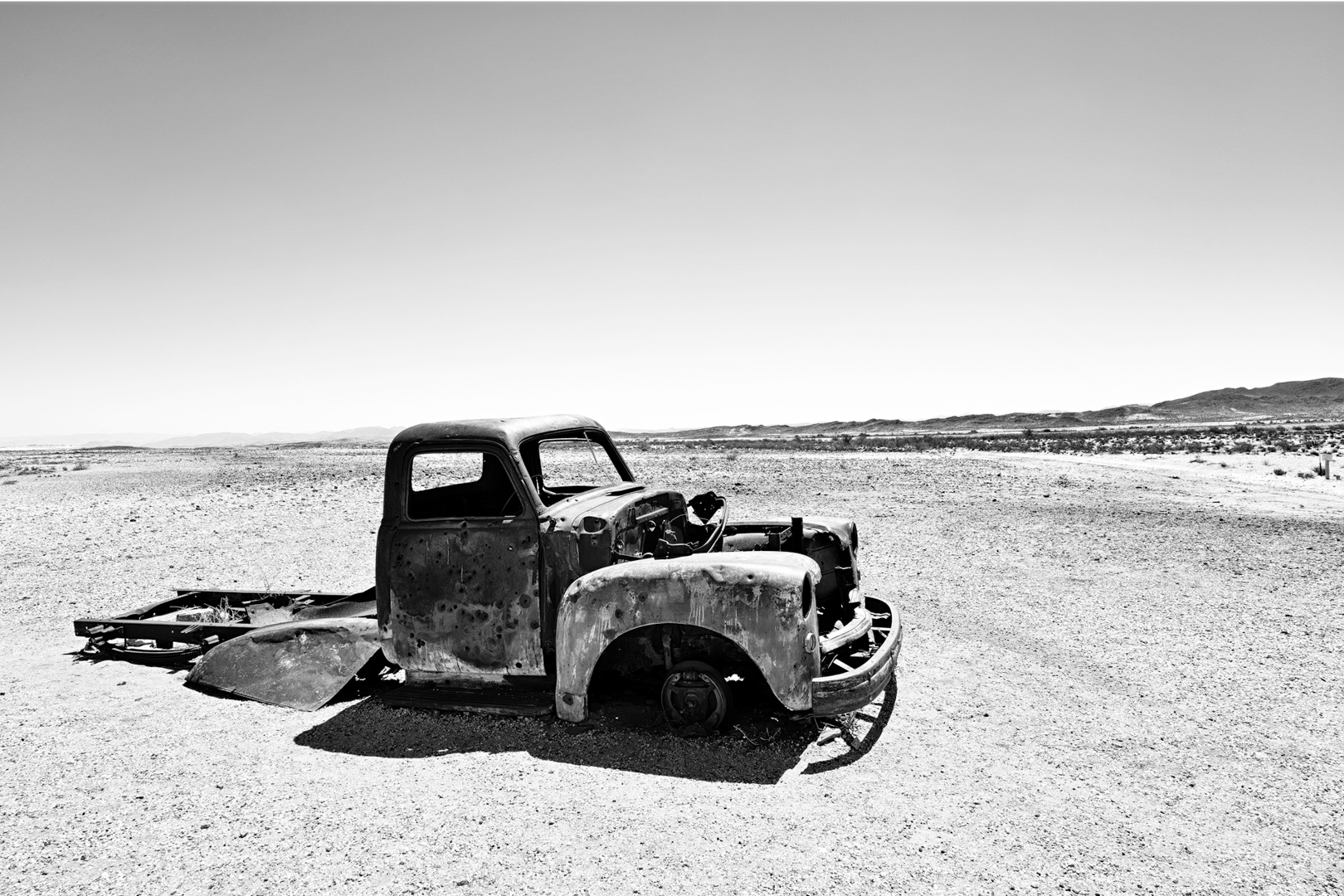
“No Name, No Road – Ai-Ais, Namibia” stands alone beneath an immense African sky—a nameless pickup, stripped of almost everything that once gave it purpose, abandoned in the arid country surrounding Ai-Ais and the Fish River Canyon in southern Namibia.
Photographed digitally in stark black and white, the image is built around two overwhelming ideas: vastness and solitude.
The vehicle occupies only a fraction of the landscape. Beyond it stretches an enormous plain of gravel and dust, dissolving toward distant ridges beneath a sky deliberately allowed to consume much of the composition. There are no buildings, no people and no obvious destination. Even the road seems to have disappeared.
What remains is a machine that once existed entirely for movement, now permanently still.
Its identity has largely vanished with it.
The manufacturer's insignia is gone. Much of the front assembly has disappeared. The engine bay lies exposed, the load bed has collapsed to little more than its frame, and decades of heat and weather have reduced painted steel to a scarred surface of corrosion and memory.
Once, somebody drove this vehicle.
It carried something.
It travelled somewhere.
Someone closed its door, held its steering wheel and looked through those same windows toward a destination.
None of that history is available to us now.
James 4:14
Whereas you do not know what will happen tomorrow.
For what is your life? It is even a vapor that appears for a little time and then vanishes away.
The words of James 4:14 give No Name, No Road its deeper resonance.
The abandoned vehicle becomes a quiet measure of human impermanence. It was manufactured with a name, a purpose and an owner. It represented usefulness and movement; perhaps even livelihood. Yet time has removed almost every trace of those distinctions.
The desert has no interest in marque or status.
Against the geological scale of southern Namibia, the machine's deterioration seems almost instantaneous. Mountains endure on the horizon while steel corrodes in the foreground. Human manufacture and geological time occupy the same photograph, but they operate according to vastly different clocks.
Black and white reinforces that relationship.
Without colour, rust ceases to be merely brown metal and becomes texture. The battered panels, empty windows, exposed chassis and bleached gravel are drawn together through light and shadow. The vehicle no longer feels separate from its surroundings. Slowly, visually and physically, it is becoming part of them.
The enormous negative space above the pickup is equally important. The sky dwarfs the abandoned machine, allowing the composition to breathe while intensifying its isolation. What might once have commanded attention on a road now appears small beneath the scale of creation.
There is also an irony embedded in the title.
A vehicle exists to follow roads.
Here, there is effectively no road left to follow.
A vehicle is identified by its manufacturer.
Here, there is no name left to read.
What survives is the evidence that something once passed through this place.
No Name, No Road therefore becomes less a photograph of an old pickup than a meditation on the temporary nature of possession, usefulness and human endeavour. The object remains, but its original importance has vanished. The desert continues around it without explanation.
As the penultimate work in this Richtersveld and Orange River journey, the photograph marks a significant transition. The preceding images explored what survives this landscape—the river bringing life through desert, vegetation taking root in hostile ground, and a solitary tree holding fast among stone.
Here, the subject is different.
Nature endures.
The manufactured object does not.
The final photograph, made from within the remains of this vehicle, can take that meditation one step further—placing the viewer where its unknown driver once sat and allowing us, briefly, to look outward through their abandoned frame.
This is a signed and embossed Limited Edition print, strictly limited to just 25 pieces, ensuring its exclusivity.
No Name, No Road – Ai-Ais, Namibia
No Name, No Road – Ai-Ais, Namibia
“No Name, No Road – Ai-Ais, Namibia” stands alone beneath an immense African sky—a nameless pickup, stripped of almost everything that once gave it purpose, abandoned in the arid country surrounding Ai-Ais and the Fish River Canyon in southern Namibia.
Photographed digitally in stark black and white, the image is built around two overwhelming ideas: vastness and solitude.
The vehicle occupies only a fraction of the landscape. Beyond it stretches an enormous plain of gravel and dust, dissolving toward distant ridges beneath a sky deliberately allowed to consume much of the composition. There are no buildings, no people and no obvious destination. Even the road seems to have disappeared.
What remains is a machine that once existed entirely for movement, now permanently still.
Its identity has largely vanished with it.
The manufacturer's insignia is gone. Much of the front assembly has disappeared. The engine bay lies exposed, the load bed has collapsed to little more than its frame, and decades of heat and weather have reduced painted steel to a scarred surface of corrosion and memory.
Once, somebody drove this vehicle.
It carried something.
It travelled somewhere.
Someone closed its door, held its steering wheel and looked through those same windows toward a destination.
None of that history is available to us now.
James 4:14
Whereas you do not know what will happen tomorrow.
For what is your life? It is even a vapor that appears for a little time and then vanishes away.
The words of James 4:14 give No Name, No Road its deeper resonance.
The abandoned vehicle becomes a quiet measure of human impermanence. It was manufactured with a name, a purpose and an owner. It represented usefulness and movement; perhaps even livelihood. Yet time has removed almost every trace of those distinctions.
The desert has no interest in marque or status.
Against the geological scale of southern Namibia, the machine's deterioration seems almost instantaneous. Mountains endure on the horizon while steel corrodes in the foreground. Human manufacture and geological time occupy the same photograph, but they operate according to vastly different clocks.
Black and white reinforces that relationship.
Without colour, rust ceases to be merely brown metal and becomes texture. The battered panels, empty windows, exposed chassis and bleached gravel are drawn together through light and shadow. The vehicle no longer feels separate from its surroundings. Slowly, visually and physically, it is becoming part of them.
The enormous negative space above the pickup is equally important. The sky dwarfs the abandoned machine, allowing the composition to breathe while intensifying its isolation. What might once have commanded attention on a road now appears small beneath the scale of creation.
There is also an irony embedded in the title.
A vehicle exists to follow roads.
Here, there is effectively no road left to follow.
A vehicle is identified by its manufacturer.
Here, there is no name left to read.
What survives is the evidence that something once passed through this place.
No Name, No Road therefore becomes less a photograph of an old pickup than a meditation on the temporary nature of possession, usefulness and human endeavour. The object remains, but its original importance has vanished. The desert continues around it without explanation.
As the penultimate work in this Richtersveld and Orange River journey, the photograph marks a significant transition. The preceding images explored what survives this landscape—the river bringing life through desert, vegetation taking root in hostile ground, and a solitary tree holding fast among stone.
Here, the subject is different.
Nature endures.
The manufactured object does not.
The final photograph, made from within the remains of this vehicle, can take that meditation one step further—placing the viewer where its unknown driver once sat and allowing us, briefly, to look outward through their abandoned frame.
This is a signed and embossed Limited Edition print, strictly limited to just 25 pieces, ensuring its exclusivity.
Price range: $800.00 through $1 300.00
Print Information
The Cameras
Your Subtitle Goes Here
Every photograph begins with the camera it was created on. Whether captured on traditional photographic film or a modern digital camera, every image is produced with the same commitment to craftsmanship and authenticity.
Film negatives and transparencies are personally developed by hand before being professionally scanned and prepared for printing. Digital photographs are captured in RAW format and carefully processed to preserve the original scene rather than alter it.
Large Format
Shen-Hao 4×5
4×10
5×7
8×10
Korona 7×17
Pinhole Cameras
Medium Format
Baby Rolleiflex
Yashica 44
Yashica Mat 124
Pentax 645N
Mamiya 645 1000S
Pentax 6×7
Fuji GX617 Professional
Various panoramic roll-film systems
35mm
Nikon F5
Nikon F6
Digital
Nikon D800E
Nikon D4
Nikon D5
Fujifilm GFX100
The Collections
Your Subtitle Goes Here
Every collection represents years of exploration, patience and careful craftsmanship. Some photographs are captured digitally, while others originate on traditional photographic film.
Film photographs are developed by hand before being scanned using professional equipment. Digital RAW files receive only careful tonal and colour refinement, preserving the integrity of the original photograph.
Collections are available as either Open Editions or Limited Editions, depending on the artwork.
The Triptych Collection Sizes
Your Subtitle Goes Here
Triptych Size Guide
For Triptych Collection artworks, the selected size applies consistently across all three panels.
In compositions where the side panels are portrait and the centre panel is landscape, the selected size refers to the maximum height of the artwork. For example, when A3 is selected, the two portrait side panels are produced to the A3 long dimension, and the centre landscape panel is scaled proportionally to match that same height.
Where all three panels are landscape or all three are portrait, the selected format remains consistent throughout the set — A0 is A0, A1 is A1, A2 is A2 and A3 is A3. Sizes are not mixed between panels.
Available Triptych Collection sizes: A0, A1, A2 and A3.
The Editions
Your Subtitle Goes Here
Limited Editions
Limited Editions are permanently restricted to 25 prints worldwide, regardless of the size or medium selected.
Once the edition has sold out, no additional prints of that artwork will ever be produced.
Signing & Numbering
Every Open and Limited Edition print is individually signed, embossed and accompanied by a Certificate of Authenticity.
Each Limited Edition print is hand-numbered—for example: 10/25
This indicates the tenth print produced from a total edition of twenty-five.
The Photographic Process
Your Subtitle Goes Here
Many CFP Prints artworks begin with traditional photographic film.
Each negative or transparency is developed by hand using carefully selected chemistry before being professionally scanned for printing. Every stage of the workflow is managed with the objective of faithfully reproducing the original photograph rather than digitally transforming it.
Every photograph represents a real moment, captured through experience, patience and light—not artificial intelligence.
The Printed Medium
Your Subtitle Goes Here
CFP Prints is produced exclusively on museum-quality Hahnemühle FineArt media.
Hahnemühle Cézanne Canvas
A 430 gsm, 100% cotton canvas offering exceptional colour depth, fine detail and long-term archival stability. Its natural matte surface makes it ideal for gallery-quality presentation.
Hahnemühle Photo Rag® Matt Baryta
A 308 gsm, a natural white, 100% cotton paper with a traditional barium sulphate coating. This paper offers rich blacks, luminous highlights, and refined surface texture. It is acid- and lignin-free, with certified age resistance.
Certificate of Authenticity
Your Subtitle Goes Here
Every CFP Prints artwork is accompanied by a Certificate of Authenticity (CoA)—a signed and embossed document that formally certifies the originality, provenance, and technical details of the artwork.
Issued with both Limited Edition and Open Edition works, the certificate confirms that the artwork was produced exclusively by CFP Prints using museum-quality archival materials and professional printing standards.
Collectors, galleries, and institutions are encouraged to retain the Certificate of Authenticity with the artwork at all times. It forms an important part of the artwork’s provenance and assists in verifying authenticity for resale, exhibition, insurance, and archival cataloguing.
Caring for Your Print
Your Subtitle Goes Here
Every CFP Prints artwork is produced using museum-quality archival materials designed to provide exceptional longevity when properly cared for.
To help preserve the beauty of your artwork for generations:
- Avoid prolonged exposure to direct sunlight or strong reflected light.
- Dust gently with a soft, dry microfibre cloth or soft artist’s brush. Never use household cleaners, solvents, or abrasive materials.
- Display or store your artwork in a dry, temperature-controlled environment, away from excessive humidity or heat.
- Canvas prints are protected with a professional matte archival varnish and may be gently cleaned with a soft, slightly damp cloth when necessary.
With appropriate care, your CFP Prints artwork will retain its richness, detail, and archival quality for many years.