
Strength in the Barren Land – Rosh Pinah

Strength in the Barren Land – Rosh Pinah
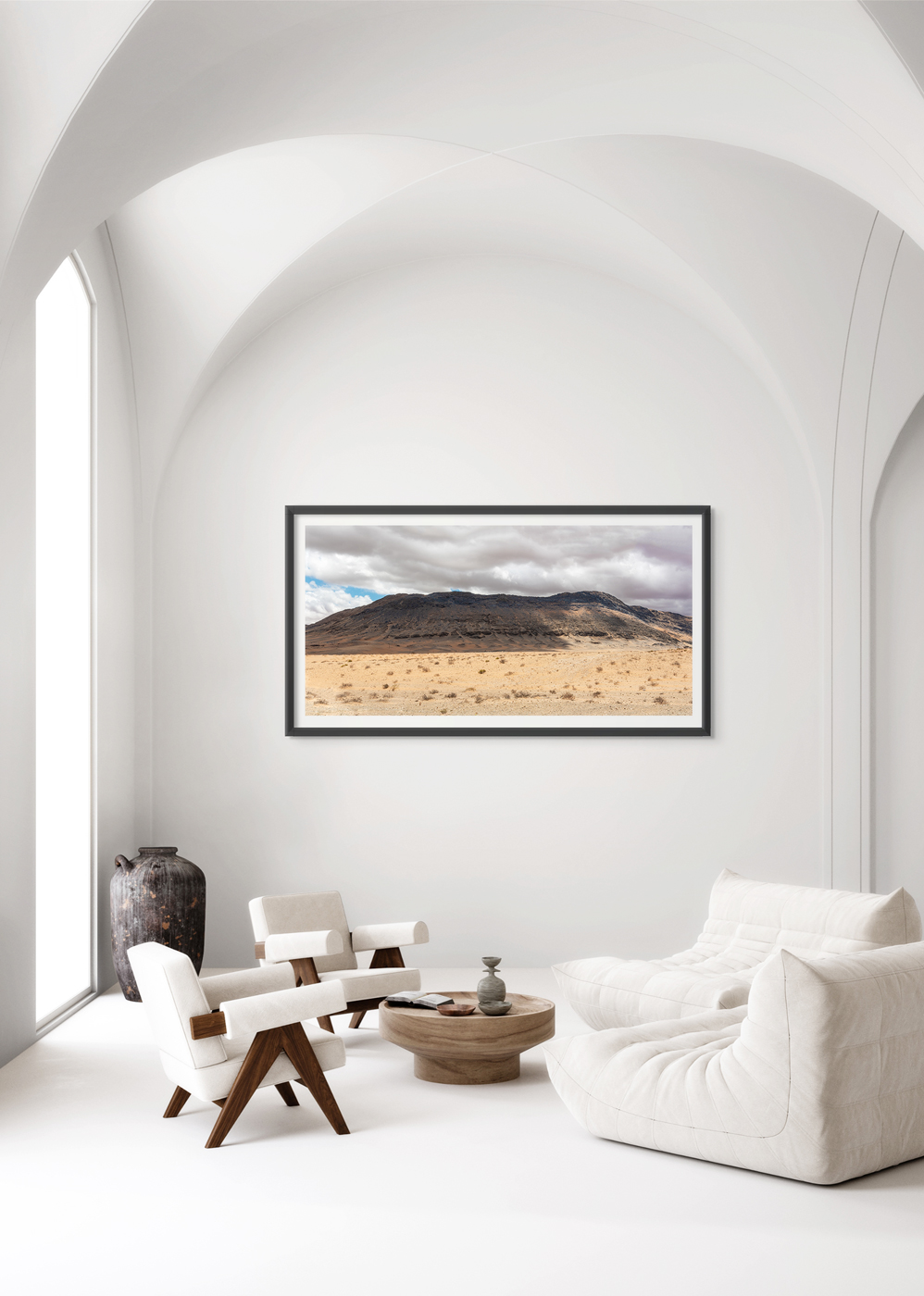
“Strength in the Barren Land – Rosh Pinah, Richtersveld” stretches across the edge of one of Southern Africa’s most austere environments, where an immense dark escarpment rises abruptly from an open desert plain. Photographed digitally in panoramic format in the Rosh Pinah region on the boundaries of the Richtersveld, the image is a study of endurance, scale and the extraordinary beauty concealed within apparent desolation.
The foreground is sparse almost to the point of emptiness. Pale sand and gravel extend across the frame, interrupted only by scattered shrubs that have somehow established themselves within this severe environment. Each small plant becomes significant against the immensity surrounding it—a quiet declaration that life does not always require abundance to endure.
Beyond the plain, the mountain rises like a wall.
Its dark, weathered surface stretches almost uninterrupted from one side of the panorama to the other. Layers of exposed rock, scree and erosion trace countless passages of time across its face. There is little softness here. The landscape has been reduced to elemental components: stone, sand, sky and light.
Yet light transforms everything.
Breaking through the heavy cloud cover, sunlight moves selectively across the escarpment and desert floor. Portions of the mountain briefly emerge from shadow before disappearing again beneath the passing weather. The effect gives the landscape an extraordinary dimensionality, revealing subtle variations of charcoal, bronze, ochre and muted gold within terrain that might otherwise appear monochromatic.
Above, an enormous ceiling of cloud presses down upon the mountains. Its weight seems almost tangible, creating a dramatic counterpoint to the horizontal openness of the panoramic composition. Small openings of blue sky offer moments of relief, while the shifting light suggests that this apparently static landscape is continually changing.
The Richtersveld and its surrounding desert regions demand adaptation from everything that survives here. Rainfall is scarce, temperatures can be severe, and vegetation must exploit the smallest opportunities offered by moisture, shade and terrain. Life exists not through excess, but through remarkable economy.
That reality provides the spiritual foundation for Strength in the Barren Land.
Isaiah 41:18–20
I will open rivers in desolate heights,
And fountains in the midst of the valleys;
I will make the wilderness a pool of water,
And the dry land springs of water.
I will plant in the wilderness the cedar and the acacia tree,
The myrtle and the oil tree;
I will set in the desert the cypress tree and the pine
And the box tree together,
That they may see and know,
And consider and understand together,
That the hand of the Lord has done this.
Against this landscape, the words of Isaiah 41:18–20 acquire an almost physical presence. The wilderness is not portrayed as worthless because it is dry, nor is apparent barrenness equated with absence. Instead, the passage speaks of possibility where none seems obvious.
The scattered vegetation across the foreground reinforces that idea. These plants are visually insignificant beside the mountain, yet their very existence becomes remarkable. They stand as small witnesses to persistence within a landscape governed by extremes.
The panoramic format is particularly important to this work. It allows the escarpment to retain its overwhelming horizontal scale while giving the desert sufficient space to breathe beneath it. Rather than isolating a single geological feature, the photograph presents the relationship between mountain, plain and sky as one continuous environment.
Strength in the Barren Land is therefore not simply an image of an arid mountain range. It is a meditation on endurance—on the ability of life to persist when circumstances appear inhospitable, and on the possibility that what seems empty may contain far more than we initially perceive.
For collectors drawn to expansive African landscapes, desert environments and work carrying a deeper spiritual narrative, this photograph offers the Richtersveld without embellishment: formidable, exposed and profoundly alive.
This is a signed and embossed Open Edition print.
Price range: $800.00 through $1 300.00
Strength in the Barren Land – Rosh Pinah
Strength in the Barren Land – Rosh Pinah
“Strength in the Barren Land – Rosh Pinah, Richtersveld” stretches across the edge of one of Southern Africa’s most austere environments, where an immense dark escarpment rises abruptly from an open desert plain. Photographed digitally in panoramic format in the Rosh Pinah region on the boundaries of the Richtersveld, the image is a study of endurance, scale and the extraordinary beauty concealed within apparent desolation.
The foreground is sparse almost to the point of emptiness. Pale sand and gravel extend across the frame, interrupted only by scattered shrubs that have somehow established themselves within this severe environment. Each small plant becomes significant against the immensity surrounding it—a quiet declaration that life does not always require abundance to endure.
Beyond the plain, the mountain rises like a wall.
Its dark, weathered surface stretches almost uninterrupted from one side of the panorama to the other. Layers of exposed rock, scree and erosion trace countless passages of time across its face. There is little softness here. The landscape has been reduced to elemental components: stone, sand, sky and light.
Yet light transforms everything.
Breaking through the heavy cloud cover, sunlight moves selectively across the escarpment and desert floor. Portions of the mountain briefly emerge from shadow before disappearing again beneath the passing weather. The effect gives the landscape an extraordinary dimensionality, revealing subtle variations of charcoal, bronze, ochre and muted gold within terrain that might otherwise appear monochromatic.
Above, an enormous ceiling of cloud presses down upon the mountains. Its weight seems almost tangible, creating a dramatic counterpoint to the horizontal openness of the panoramic composition. Small openings of blue sky offer moments of relief, while the shifting light suggests that this apparently static landscape is continually changing.
The Richtersveld and its surrounding desert regions demand adaptation from everything that survives here. Rainfall is scarce, temperatures can be severe, and vegetation must exploit the smallest opportunities offered by moisture, shade and terrain. Life exists not through excess, but through remarkable economy.
That reality provides the spiritual foundation for Strength in the Barren Land.
Isaiah 41:18–20
I will open rivers in desolate heights,
And fountains in the midst of the valleys;
I will make the wilderness a pool of water,
And the dry land springs of water.
I will plant in the wilderness the cedar and the acacia tree,
The myrtle and the oil tree;
I will set in the desert the cypress tree and the pine
And the box tree together,
That they may see and know,
And consider and understand together,
That the hand of the Lord has done this.
Against this landscape, the words of Isaiah 41:18–20 acquire an almost physical presence. The wilderness is not portrayed as worthless because it is dry, nor is apparent barrenness equated with absence. Instead, the passage speaks of possibility where none seems obvious.
The scattered vegetation across the foreground reinforces that idea. These plants are visually insignificant beside the mountain, yet their very existence becomes remarkable. They stand as small witnesses to persistence within a landscape governed by extremes.
The panoramic format is particularly important to this work. It allows the escarpment to retain its overwhelming horizontal scale while giving the desert sufficient space to breathe beneath it. Rather than isolating a single geological feature, the photograph presents the relationship between mountain, plain and sky as one continuous environment.
Strength in the Barren Land is therefore not simply an image of an arid mountain range. It is a meditation on endurance—on the ability of life to persist when circumstances appear inhospitable, and on the possibility that what seems empty may contain far more than we initially perceive.
For collectors drawn to expansive African landscapes, desert environments and work carrying a deeper spiritual narrative, this photograph offers the Richtersveld without embellishment: formidable, exposed and profoundly alive.
This is a signed and embossed Open Edition print.
Price range: $800.00 through $1 300.00
Print Information
The Cameras
Your Subtitle Goes Here
Every photograph begins with the camera it was created on. Whether captured on traditional photographic film or a modern digital camera, every image is produced with the same commitment to craftsmanship and authenticity.
Film negatives and transparencies are personally developed by hand before being professionally scanned and prepared for printing. Digital photographs are captured in RAW format and carefully processed to preserve the original scene rather than alter it.
Large Format
Shen-Hao 4×5
4×10
5×7
8×10
Korona 7×17
Pinhole Cameras
Medium Format
Baby Rolleiflex
Yashica 44
Yashica Mat 124
Pentax 645N
Mamiya 645 1000S
Pentax 6×7
Fuji GX617 Professional
Various panoramic roll-film systems
35mm
Nikon F5
Nikon F6
Digital
Nikon D800E
Nikon D4
Nikon D5
Fujifilm GFX100
The Collections
Your Subtitle Goes Here
Every collection represents years of exploration, patience and careful craftsmanship. Some photographs are captured digitally, while others originate on traditional photographic film.
Film photographs are developed by hand before being scanned using professional equipment. Digital RAW files receive only careful tonal and colour refinement, preserving the integrity of the original photograph.
Collections are available as either Open Editions or Limited Editions, depending on the artwork.
The Triptych Collection Sizes
Your Subtitle Goes Here
Triptych Size Guide
For Triptych Collection artworks, the selected size applies consistently across all three panels.
In compositions where the side panels are portrait and the centre panel is landscape, the selected size refers to the maximum height of the artwork. For example, when A3 is selected, the two portrait side panels are produced to the A3 long dimension, and the centre landscape panel is scaled proportionally to match that same height.
Where all three panels are landscape or all three are portrait, the selected format remains consistent throughout the set — A0 is A0, A1 is A1, A2 is A2 and A3 is A3. Sizes are not mixed between panels.
Available Triptych Collection sizes: A0, A1, A2 and A3.
The Editions
Your Subtitle Goes Here
Limited Editions
Limited Editions are permanently restricted to 25 prints worldwide, regardless of the size or medium selected.
Once the edition has sold out, no additional prints of that artwork will ever be produced.
Signing & Numbering
Every Open and Limited Edition print is individually signed, embossed and accompanied by a Certificate of Authenticity.
Each print is hand-numbered—for example: 10/25
This indicates the tenth print produced from a total edition of twenty-five.
The Photographic Process
Your Subtitle Goes Here
Many CFP Prints artworks begin with traditional photographic film.
Each negative or transparency is developed by hand using carefully selected chemistry before being professionally scanned for printing. Every stage of the workflow is managed with the objective of faithfully reproducing the original photograph rather than digitally transforming it.
Every photograph represents a real moment, captured through experience, patience and light—not artificial intelligence.
The Printed Medium
Your Subtitle Goes Here
CFP Prints is produced exclusively on museum-quality Hahnemühle FineArt media.
Hahnemühle Cézanne Canvas
A 430 gsm, 100% cotton canvas offering exceptional colour depth, fine detail and long-term archival stability. Its natural matte surface makes it ideal for gallery-quality presentation.
Hahnemühle Photo Rag® Matt Baryta
A 308 gsm, a natural white, 100% cotton paper with a traditional barium sulphate coating. This paper offers rich blacks, luminous highlights, and refined surface texture. It is acid- and lignin-free, with certified age resistance.
Certificate of Authenticity
Your Subtitle Goes Here
Every CFP Prints artwork is accompanied by a Certificate of Authenticity (CoA)—a signed and embossed document that formally certifies the originality, provenance, and technical details of the artwork.
Issued with both Limited Edition and Open Edition works, the certificate confirms that the artwork was produced exclusively by CFP Prints using museum-quality archival materials and professional printing standards.
Collectors, galleries, and institutions are encouraged to retain the Certificate of Authenticity with the artwork at all times. It forms an important part of the artwork’s provenance and assists in verifying authenticity for resale, exhibition, insurance, and archival cataloguing.
Caring for Your Print
Your Subtitle Goes Here
Every CFP Prints artwork is produced using museum-quality archival materials designed to provide exceptional longevity when properly cared for.
To help preserve the beauty of your artwork for generations:
- Avoid prolonged exposure to direct sunlight or strong reflected light.
- Dust gently with a soft, dry microfibre cloth or soft artist’s brush. Never use household cleaners, solvents, or abrasive materials.
- Display or store your artwork in a dry, temperature-controlled environment, away from excessive humidity or heat.
- Canvas prints are protected with a professional matte archival varnish and may be gently cleaned with a soft, slightly damp cloth when necessary.
With appropriate care, your CFP Prints artwork will retain its richness, detail, and archival quality for many years.