
Still I Stand – Richtersveld, Namibia
Price range: $800.00 through $1 300.00
Still I Stand – Richtersveld, Namibia
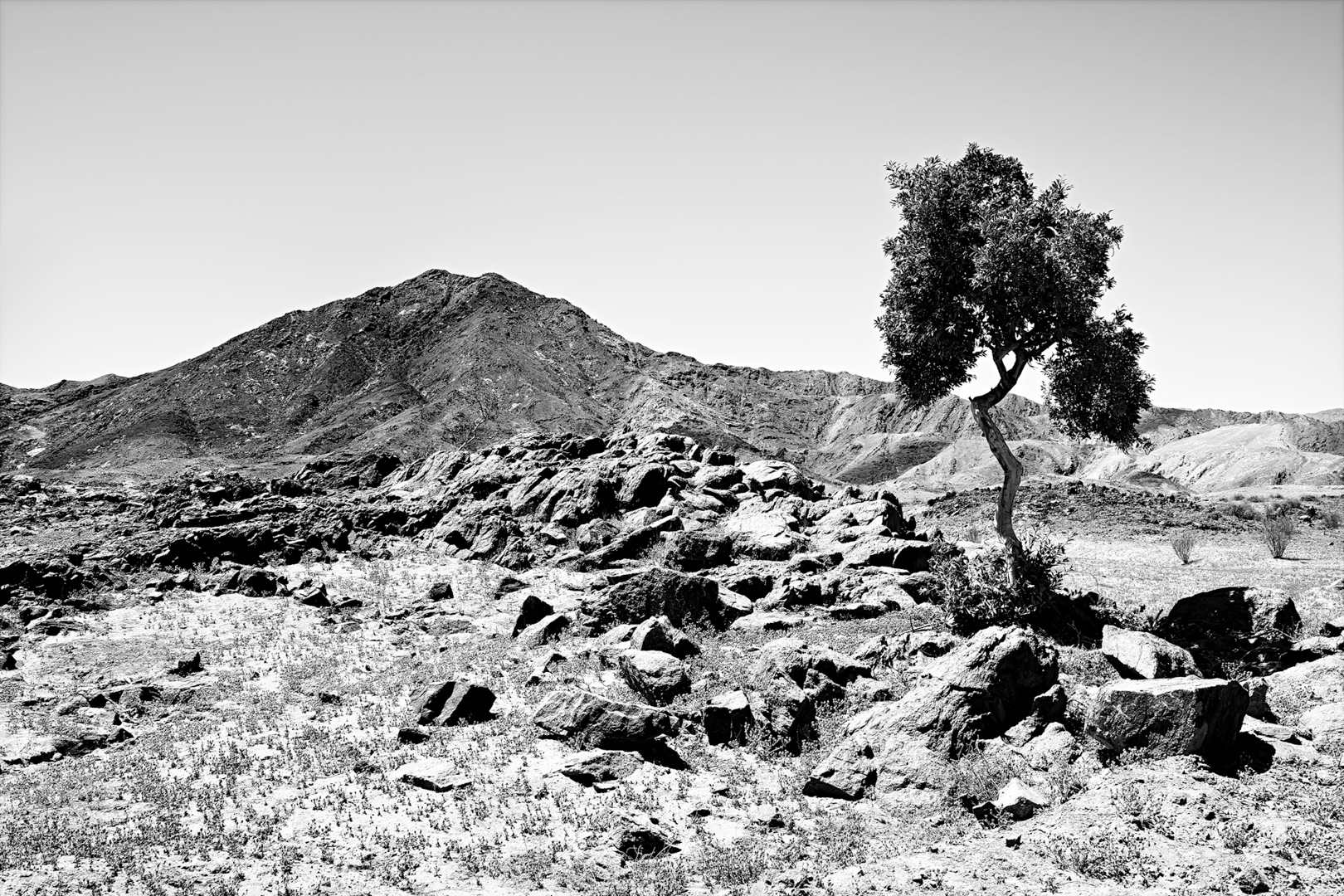
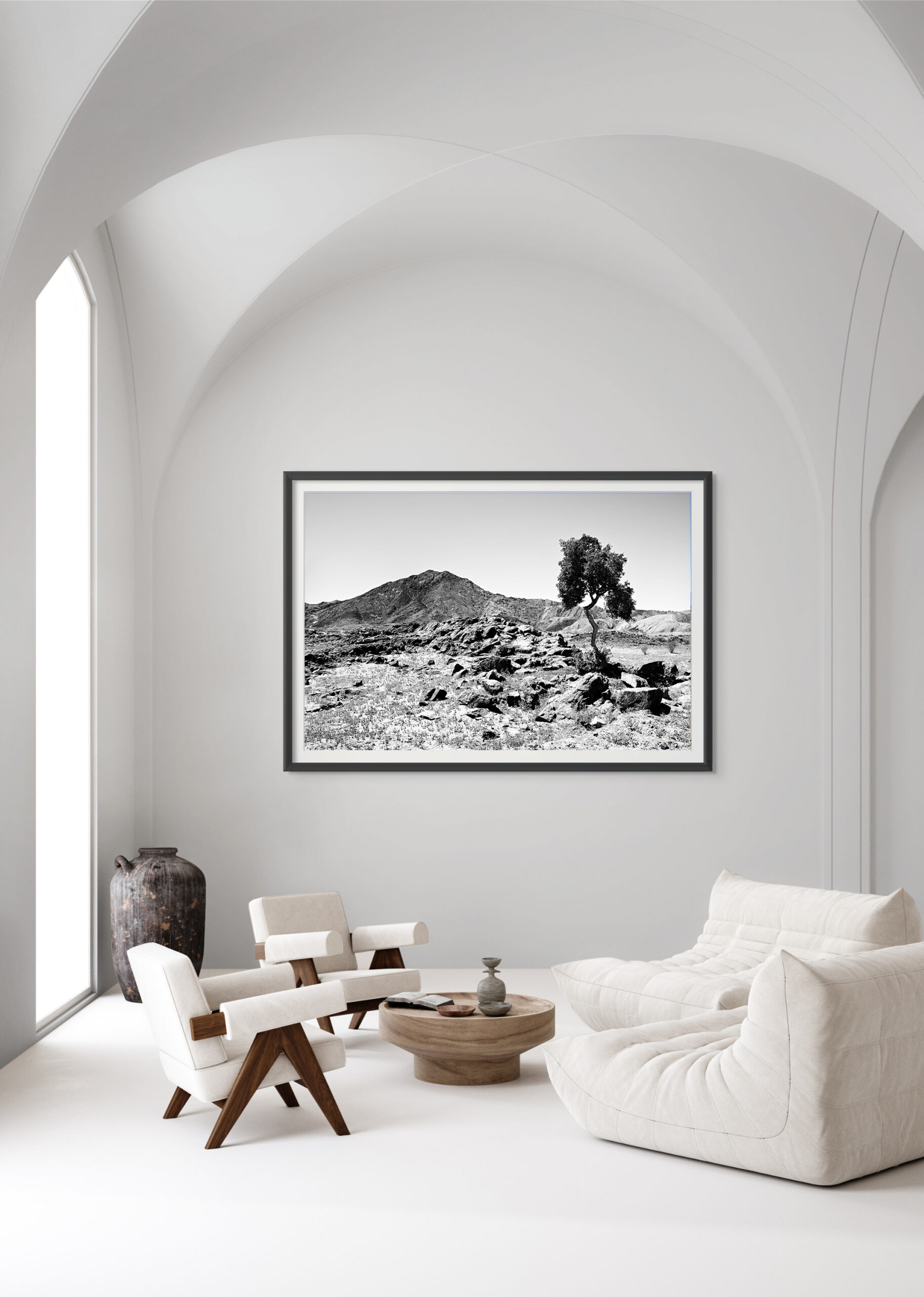
“Still I Stand – Richtersveld, Namibia” is a stark black and white study of endurance in one of Southern Africa’s most uncompromising landscapes. Photographed digitally while following the Orange River through the Namibian reaches of the Richtersveld, the image isolates a solitary tree rooted among fractured rock, seemingly holding onto life where almost nothing appears willing to grow.
There is no shade beyond what the tree can provide for itself.
No visible water.
No soft earth.
Around it lies an immense landscape of stone—broken ridges, exposed mountains and a foreground scattered with angular rock beneath the hard morning sun. Yet from this severe terrain rises a living form, its trunk twisted by circumstance but its crown remarkably full.
The tree does not dominate the landscape through scale.
It dominates through persistence.
Jeremiah 17:7–8
Blessed is the man who trusts in the Lord,
And whose hope is the Lord.
For he shall be like a tree planted by the waters,
Which spreads out its roots by the river,
And will not fear when heat comes;
But its leaf will be green,
And will not be anxious in the year of drought,
Nor will cease from yielding fruit.
Jeremiah 17:7–8 could scarcely find a more fitting visual expression.
The Orange River—the great artery through this otherwise arid country—was nearby as this photograph was made, yet the water itself lies beyond the composition. What remains visible is the consequence of finding life close enough to its influence: a tree surviving amid a landscape that appears almost incapable of sustaining it.
The scripture does not promise that heat will never come.
It says the tree will not fear when heat comes.
That distinction lies at the heart of Still I Stand.
By this stage of the morning, the desert heat was already asserting itself. Hard sunlight fell across exposed stone, producing the severe highlights and deep shadows that give the photograph much of its monochrome character. The mountains behind the tree offer no illusion of gentleness. Their folded, eroded surfaces speak of geological time, extreme temperatures and an environment shaped by forces far beyond human scale.
Against them, the tree appears impossibly vulnerable.
Its trunk bends and twists upward between the rocks, leaning beneath a dense crown that seems almost disproportionate to the ground supporting it. The visual tension is immediate: everything about the surrounding landscape suggests scarcity, while the tree itself declares life.
Black and white strengthens that contradiction.
Removed from the green that would ordinarily identify the tree as the most obviously living element in the composition, the viewer must discover its vitality through form. The organic curves of trunk and branches stand apart from the fractured geometry surrounding them. Leaves become texture. Rock becomes structure. Mountain becomes mass.
Life and stone are reduced to the same tonal vocabulary, yet remain unmistakably different.
There is something almost defiant in the tree's posture.
Not defiance born of aggression, but the quieter strength of something that has endured because its foundations reach beyond what can be seen.
That is also what Jeremiah's imagery communicates.
Roots are hidden.
Their work happens beneath the surface.
The visible tree survives because of an unseen connection to what sustains it.
Within the broader series following the Orange River, Still I Stand therefore becomes less a portrait of the river itself and more a portrait of its influence. Earlier photographs reveal water directly, or show the exposed stones left by its retreat. Here, the river is invisible—but life testifies to its presence.
The composition becomes a meditation on faith under pressure.
There will be heat.
There will be drought.
There will be seasons when the source seems distant.
Yet what is deeply rooted can remain standing.
Still I Stand is an image of the Richtersveld reduced to its elemental language: rock, mountain, light and a solitary living tree refusing to surrender its place among them.
This is a signed and embossed Open Edition print.
Still I Stand – Richtersveld, Namibia
Still I Stand – Richtersveld, Namibia
“Still I Stand – Richtersveld, Namibia” is a stark black and white study of endurance in one of Southern Africa’s most uncompromising landscapes. Photographed digitally while following the Orange River through the Namibian reaches of the Richtersveld, the image isolates a solitary tree rooted among fractured rock, seemingly holding onto life where almost nothing appears willing to grow.
There is no shade beyond what the tree can provide for itself.
No visible water.
No soft earth.
Around it lies an immense landscape of stone—broken ridges, exposed mountains and a foreground scattered with angular rock beneath the hard morning sun. Yet from this severe terrain rises a living form, its trunk twisted by circumstance but its crown remarkably full.
The tree does not dominate the landscape through scale.
It dominates through persistence.
Jeremiah 17:7–8
Blessed is the man who trusts in the Lord,
And whose hope is the Lord.
For he shall be like a tree planted by the waters,
Which spreads out its roots by the river,
And will not fear when heat comes;
But its leaf will be green,
And will not be anxious in the year of drought,
Nor will cease from yielding fruit.
Jeremiah 17:7–8 could scarcely find a more fitting visual expression.
The Orange River—the great artery through this otherwise arid country—was nearby as this photograph was made, yet the water itself lies beyond the composition. What remains visible is the consequence of finding life close enough to its influence: a tree surviving amid a landscape that appears almost incapable of sustaining it.
The scripture does not promise that heat will never come.
It says the tree will not fear when heat comes.
That distinction lies at the heart of Still I Stand.
By this stage of the morning, the desert heat was already asserting itself. Hard sunlight fell across exposed stone, producing the severe highlights and deep shadows that give the photograph much of its monochrome character. The mountains behind the tree offer no illusion of gentleness. Their folded, eroded surfaces speak of geological time, extreme temperatures and an environment shaped by forces far beyond human scale.
Against them, the tree appears impossibly vulnerable.
Its trunk bends and twists upward between the rocks, leaning beneath a dense crown that seems almost disproportionate to the ground supporting it. The visual tension is immediate: everything about the surrounding landscape suggests scarcity, while the tree itself declares life.
Black and white strengthens that contradiction.
Removed from the green that would ordinarily identify the tree as the most obviously living element in the composition, the viewer must discover its vitality through form. The organic curves of trunk and branches stand apart from the fractured geometry surrounding them. Leaves become texture. Rock becomes structure. Mountain becomes mass.
Life and stone are reduced to the same tonal vocabulary, yet remain unmistakably different.
There is something almost defiant in the tree's posture.
Not defiance born of aggression, but the quieter strength of something that has endured because its foundations reach beyond what can be seen.
That is also what Jeremiah's imagery communicates.
Roots are hidden.
Their work happens beneath the surface.
The visible tree survives because of an unseen connection to what sustains it.
Within the broader series following the Orange River, Still I Stand therefore becomes less a portrait of the river itself and more a portrait of its influence. Earlier photographs reveal water directly, or show the exposed stones left by its retreat. Here, the river is invisible—but life testifies to its presence.
The composition becomes a meditation on faith under pressure.
There will be heat.
There will be drought.
There will be seasons when the source seems distant.
Yet what is deeply rooted can remain standing.
Still I Stand is an image of the Richtersveld reduced to its elemental language: rock, mountain, light and a solitary living tree refusing to surrender its place among them.
This is a signed and embossed Open Edition print.
Price range: $800.00 through $1 300.00
Print Information
The Cameras
Your Subtitle Goes Here
Every photograph begins with the camera it was created on. Whether captured on traditional photographic film or a modern digital camera, every image is produced with the same commitment to craftsmanship and authenticity.
Film negatives and transparencies are personally developed by hand before being professionally scanned and prepared for printing. Digital photographs are captured in RAW format and carefully processed to preserve the original scene rather than alter it.
Large Format
Shen-Hao 4×5
4×10
5×7
8×10
Korona 7×17
Pinhole Cameras
Medium Format
Baby Rolleiflex
Yashica 44
Yashica Mat 124
Pentax 645N
Mamiya 645 1000S
Pentax 6×7
Fuji GX617 Professional
Various panoramic roll-film systems
35mm
Nikon F5
Nikon F6
Digital
Nikon D800E
Nikon D4
Nikon D5
Fujifilm GFX100
The Collections
Your Subtitle Goes Here
Every collection represents years of exploration, patience and careful craftsmanship. Some photographs are captured digitally, while others originate on traditional photographic film.
Film photographs are developed by hand before being scanned using professional equipment. Digital RAW files receive only careful tonal and colour refinement, preserving the integrity of the original photograph.
Collections are available as either Open Editions or Limited Editions, depending on the artwork.
The Triptych Collection Sizes
Your Subtitle Goes Here
Triptych Size Guide
For Triptych Collection artworks, the selected size applies consistently across all three panels.
In compositions where the side panels are portrait and the centre panel is landscape, the selected size refers to the maximum height of the artwork. For example, when A3 is selected, the two portrait side panels are produced to the A3 long dimension, and the centre landscape panel is scaled proportionally to match that same height.
Where all three panels are landscape or all three are portrait, the selected format remains consistent throughout the set — A0 is A0, A1 is A1, A2 is A2 and A3 is A3. Sizes are not mixed between panels.
Available Triptych Collection sizes: A0, A1, A2 and A3.
The Editions
Your Subtitle Goes Here
Limited Editions
Limited Editions are permanently restricted to 25 prints worldwide, regardless of the size or medium selected.
Once the edition has sold out, no additional prints of that artwork will ever be produced.
Signing & Numbering
Every Open and Limited Edition print is individually signed, embossed and accompanied by a Certificate of Authenticity.
Each Limited Edition print is hand-numbered—for example: 10/25
This indicates the tenth print produced from a total edition of twenty-five.
The Photographic Process
Your Subtitle Goes Here
Many CFP Prints artworks begin with traditional photographic film.
Each negative or transparency is developed by hand using carefully selected chemistry before being professionally scanned for printing. Every stage of the workflow is managed with the objective of faithfully reproducing the original photograph rather than digitally transforming it.
Every photograph represents a real moment, captured through experience, patience and light—not artificial intelligence.
The Printed Medium
Your Subtitle Goes Here
CFP Prints is produced exclusively on museum-quality Hahnemühle FineArt media.
Hahnemühle Cézanne Canvas
A 430 gsm, 100% cotton canvas offering exceptional colour depth, fine detail and long-term archival stability. Its natural matte surface makes it ideal for gallery-quality presentation.
Hahnemühle Photo Rag® Matt Baryta
A 308 gsm, a natural white, 100% cotton paper with a traditional barium sulphate coating. This paper offers rich blacks, luminous highlights, and refined surface texture. It is acid- and lignin-free, with certified age resistance.
Certificate of Authenticity
Your Subtitle Goes Here
Every CFP Prints artwork is accompanied by a Certificate of Authenticity (CoA)—a signed and embossed document that formally certifies the originality, provenance, and technical details of the artwork.
Issued with both Limited Edition and Open Edition works, the certificate confirms that the artwork was produced exclusively by CFP Prints using museum-quality archival materials and professional printing standards.
Collectors, galleries, and institutions are encouraged to retain the Certificate of Authenticity with the artwork at all times. It forms an important part of the artwork’s provenance and assists in verifying authenticity for resale, exhibition, insurance, and archival cataloguing.
Caring for Your Print
Your Subtitle Goes Here
Every CFP Prints artwork is produced using museum-quality archival materials designed to provide exceptional longevity when properly cared for.
To help preserve the beauty of your artwork for generations:
- Avoid prolonged exposure to direct sunlight or strong reflected light.
- Dust gently with a soft, dry microfibre cloth or soft artist’s brush. Never use household cleaners, solvents, or abrasive materials.
- Display or store your artwork in a dry, temperature-controlled environment, away from excessive humidity or heat.
- Canvas prints are protected with a professional matte archival varnish and may be gently cleaned with a soft, slightly damp cloth when necessary.
With appropriate care, your CFP Prints artwork will retain its richness, detail, and archival quality for many years.