
Jagged Teeth Of De Kelders
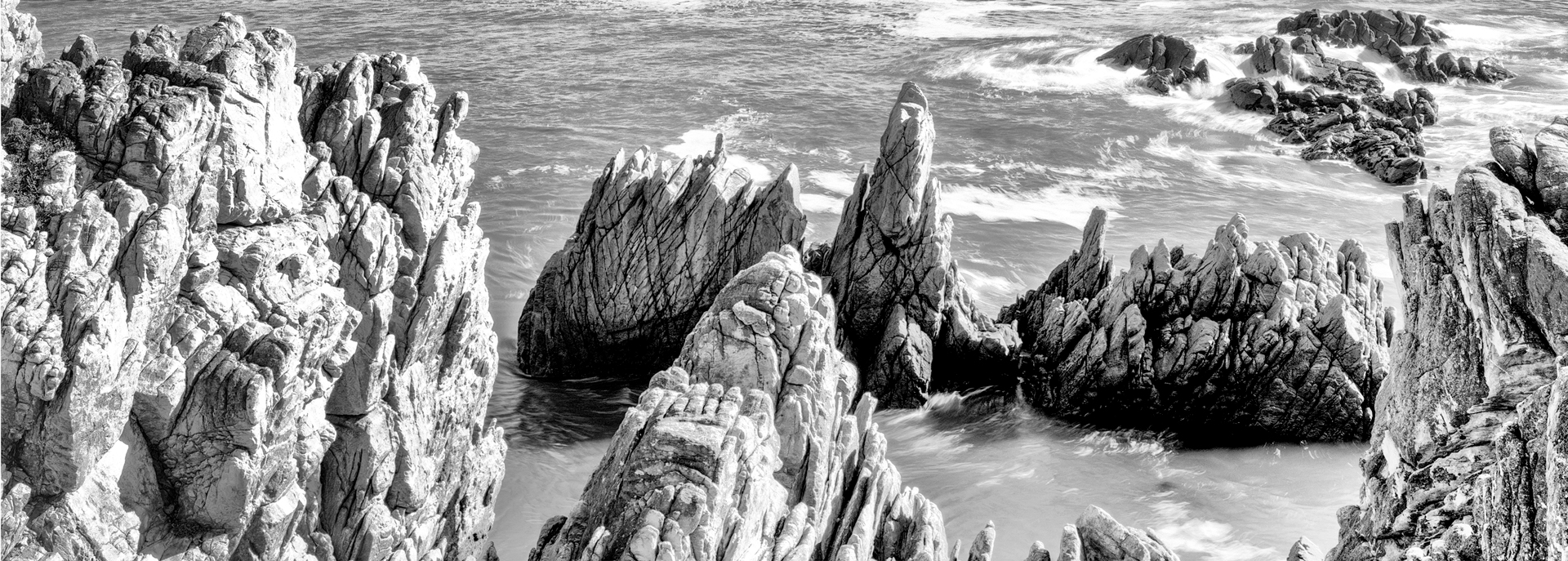
Jagged Teeth Of De Kelders
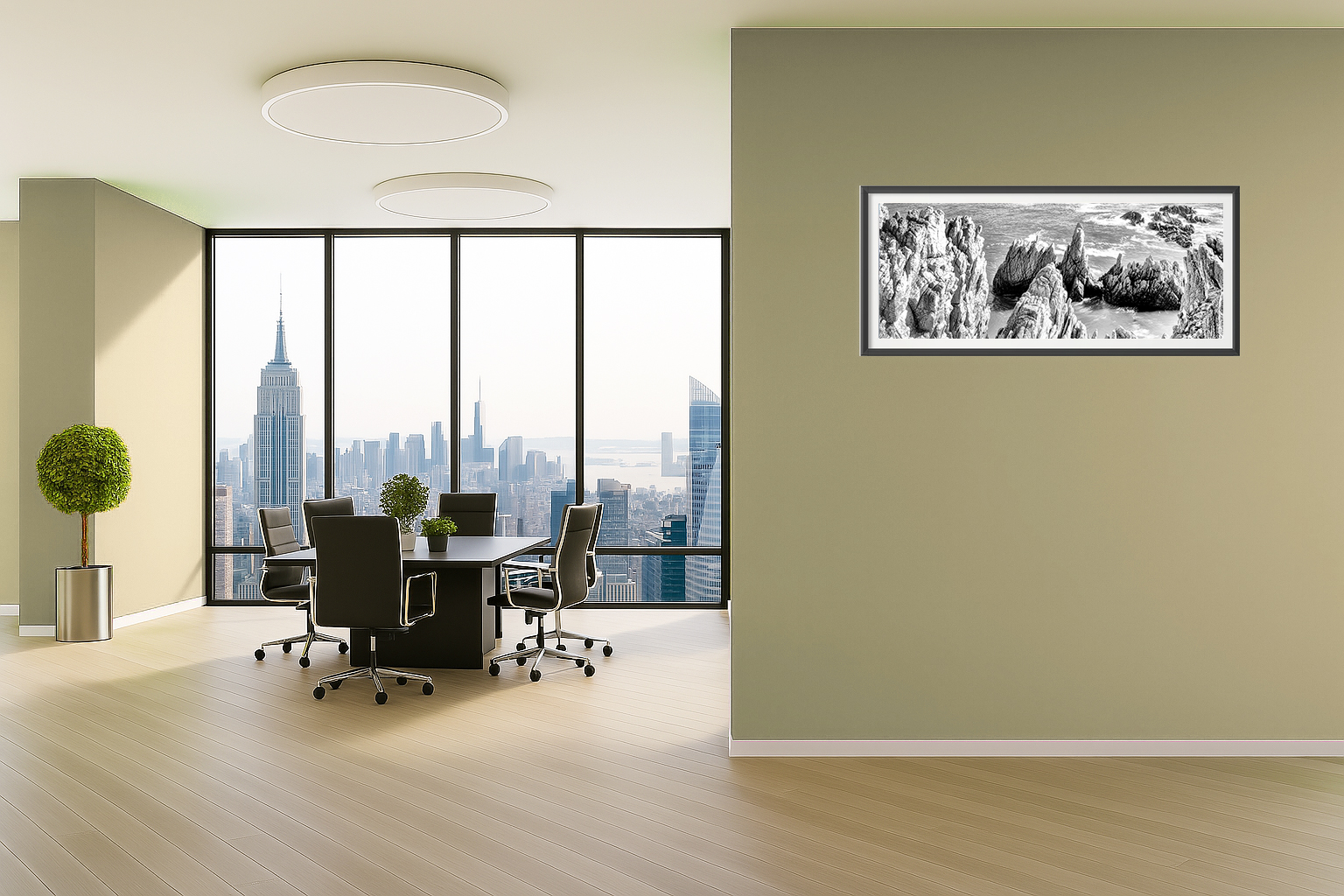
"Jagged Teeth Of De Kelders" - Along the southern coastline of South Africa, where the Atlantic Ocean meets the ancient limestone shores of De Kelders, the sea moves with a quiet persistence around formations shaped by time. Jagged Teeth Of De Kelders captures this meeting of stone and water in a high-key study of form, light and stillness.
Rows of jagged rocks emerge from the pale coastal landscape like the teeth of some ancient creature resting beneath the surface. Yet there is nothing threatening in the scene. The sea is calm, its waters swirling gently between the rocks, softening the hard geometry of the shoreline. Light fills the frame, lifting the darker forms from the surrounding tones and creating an atmosphere that is bright, airy and almost weightless.
Photographed in black and white on a 4×10 inch panoramic large format camera using Ilford Delta 100, the extended panoramic perspective allows the rocks to unfold naturally across the frame. Delta 100 is renowned for its extremely fine grain, high sharpness and beautifully controlled tonal range, making it particularly suited to the subtle transitions found in this scene. Without the distraction of colour, attention turns towards texture, shape, light and the delicate movement of water.
The high-key treatment transforms what could have been a stark coastal study into something quieter and more contemplative. The rocks retain their strength and irregularity, while the surrounding brightness creates a sense of openness and calm. Darker forms become accents within a field of light, drawing the eye along the coastline and into the spaces where sea and stone meet.
Proverbs 25:19
Like a broken tooth or a lame foot is reliance on the unfaithful in a time of trouble
The words of Proverbs introduce another dimension to these apparently peaceful forms. A tooth is strong because it is whole, secure and dependable. When broken, its strength becomes compromised. The jagged rocks of De Kelders offer a quiet visual reflection on that distinction—strength and fragility existing side by side, shaped by forces that act slowly and persistently over time.
There is also something deeply human in the contrast. The rocks appear immovable, yet the sea continually works around them. Neither dominates the scene. Instead, they exist in an enduring relationship: resistance met by persistence, permanence softened by movement.
Jagged Teeth Of De Kelders is therefore not simply a photograph of rocks along the South African coast. It is a meditation on resilience, dependence and the difference between something that merely appears strong and something that can truly be relied upon. The calm water and luminous atmosphere temper the severity of the subject, leaving the viewer with a sense of quiet reflection rather than drama.
This is a signed and embossed Open Edition print.
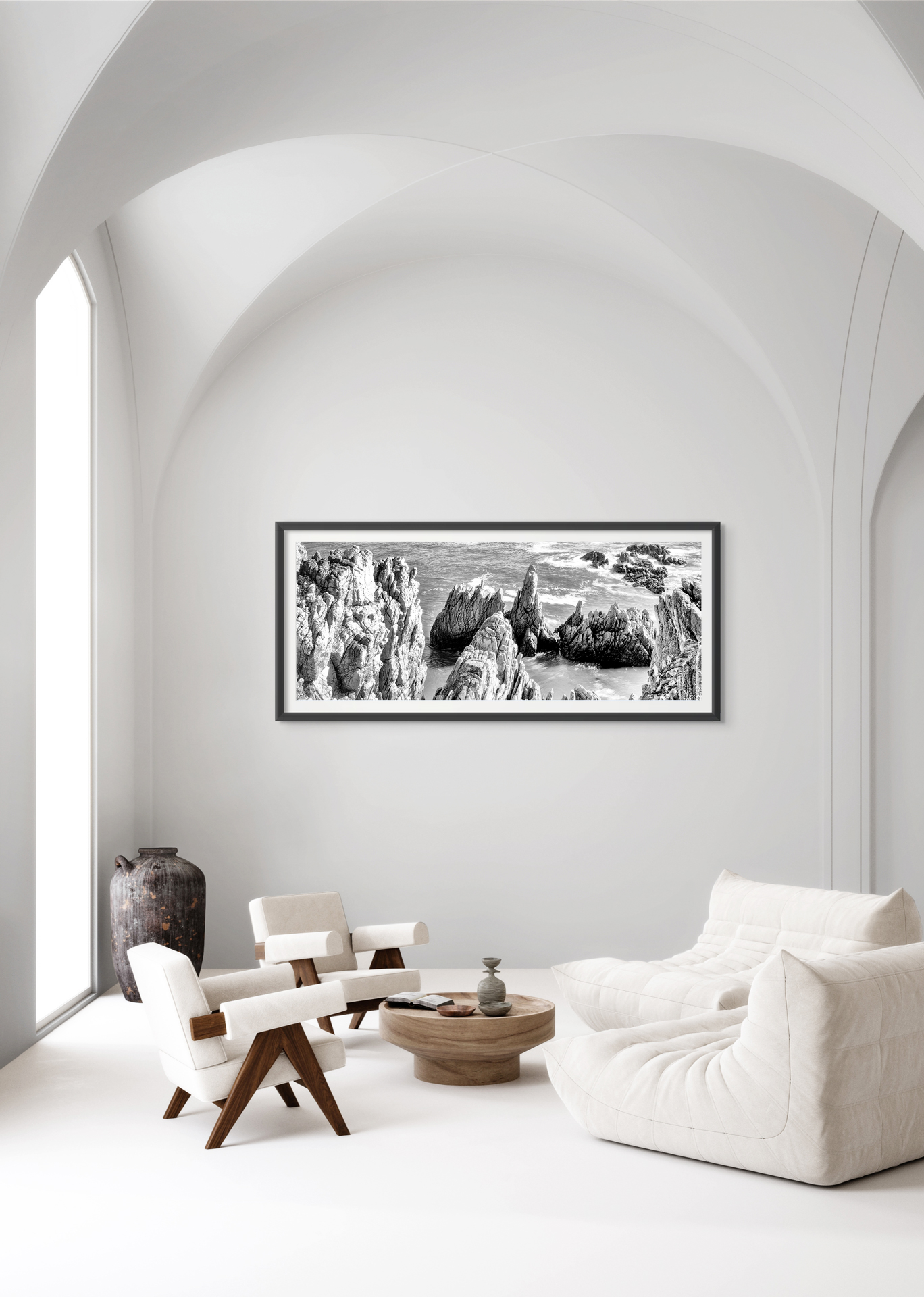
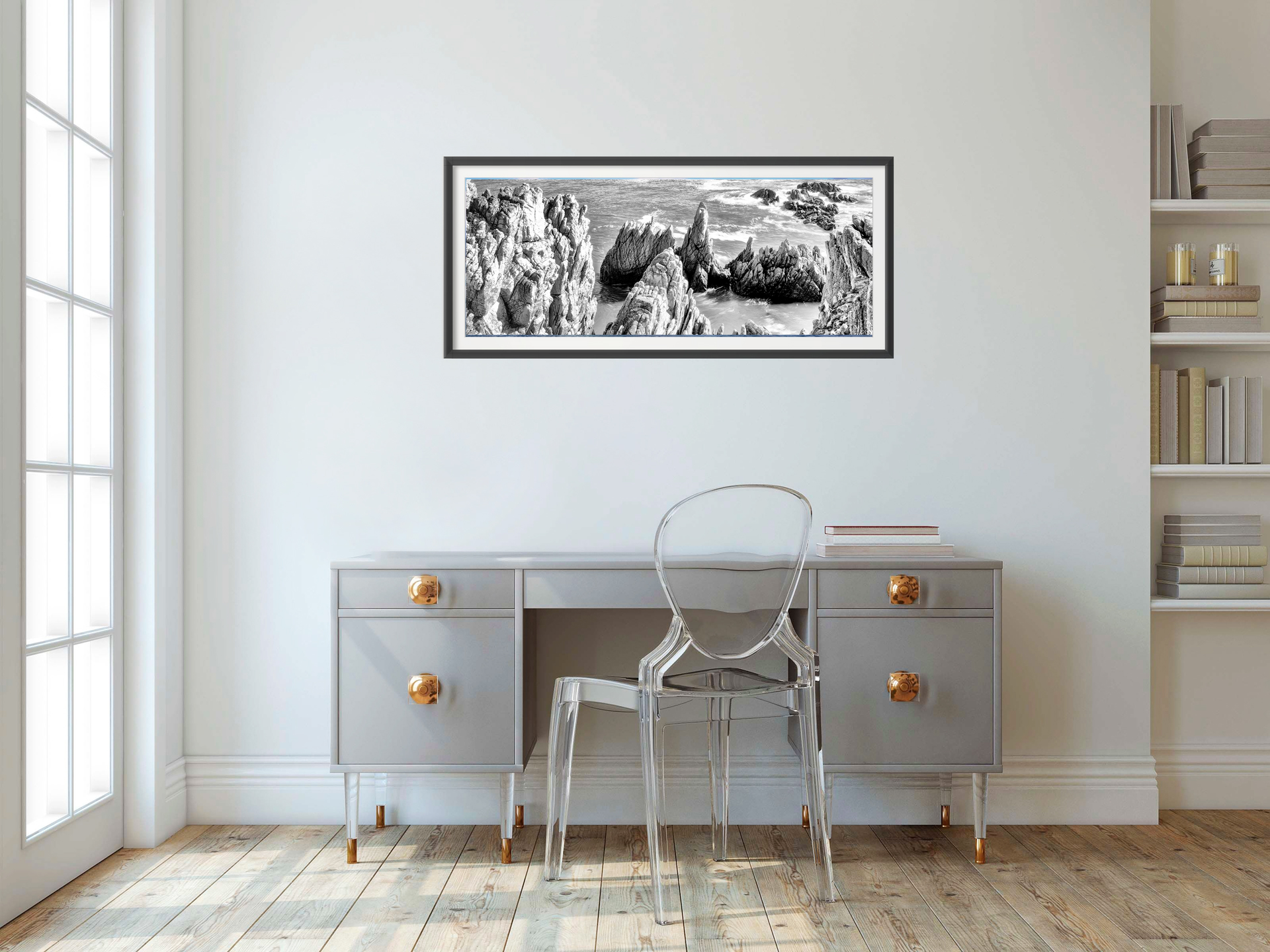
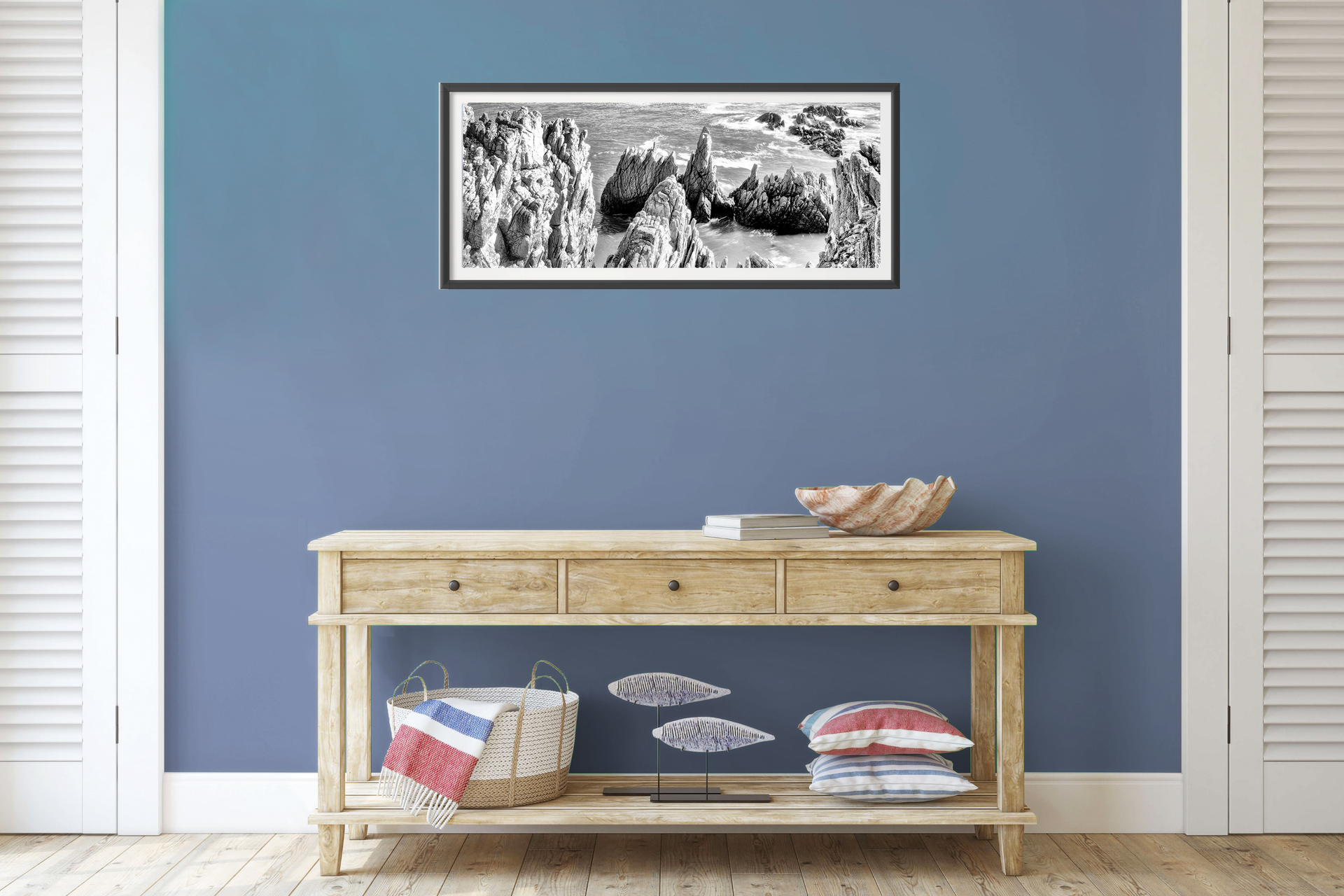

Price range: $1 050.00 through $1 350.00
Jagged Teeth Of De Kelders
Jagged Teeth Of De Kelders
"Jagged Teeth Of De Kelders" - Along the southern coastline of South Africa, where the Atlantic Ocean meets the ancient limestone shores of De Kelders, the sea moves with a quiet persistence around formations shaped by time. Jagged Teeth Of De Kelders captures this meeting of stone and water in a high-key study of form, light and stillness.
Rows of jagged rocks emerge from the pale coastal landscape like the teeth of some ancient creature resting beneath the surface. Yet there is nothing threatening in the scene. The sea is calm, its waters swirling gently between the rocks, softening the hard geometry of the shoreline. Light fills the frame, lifting the darker forms from the surrounding tones and creating an atmosphere that is bright, airy and almost weightless.
Photographed in black and white on a 4×10 inch panoramic large format camera using Ilford Delta 100, the extended panoramic perspective allows the rocks to unfold naturally across the frame. Delta 100 is renowned for its extremely fine grain, high sharpness and beautifully controlled tonal range, making it particularly suited to the subtle transitions found in this scene. Without the distraction of colour, attention turns towards texture, shape, light and the delicate movement of water.
The high-key treatment transforms what could have been a stark coastal study into something quieter and more contemplative. The rocks retain their strength and irregularity, while the surrounding brightness creates a sense of openness and calm. Darker forms become accents within a field of light, drawing the eye along the coastline and into the spaces where sea and stone meet.
Proverbs 25:19
Like a broken tooth or a lame foot is reliance on the unfaithful in a time of trouble
The words of Proverbs introduce another dimension to these apparently peaceful forms. A tooth is strong because it is whole, secure and dependable. When broken, its strength becomes compromised. The jagged rocks of De Kelders offer a quiet visual reflection on that distinction—strength and fragility existing side by side, shaped by forces that act slowly and persistently over time.
There is also something deeply human in the contrast. The rocks appear immovable, yet the sea continually works around them. Neither dominates the scene. Instead, they exist in an enduring relationship: resistance met by persistence, permanence softened by movement.
Jagged Teeth Of De Kelders is therefore not simply a photograph of rocks along the South African coast. It is a meditation on resilience, dependence and the difference between something that merely appears strong and something that can truly be relied upon. The calm water and luminous atmosphere temper the severity of the subject, leaving the viewer with a sense of quiet reflection rather than drama.
This is a signed and embossed Open Edition print.
Price range: $1 050.00 through $1 350.00
Print Information
The Cameras
Your Subtitle Goes Here
Every photograph begins with the camera it was created on. Whether captured on traditional photographic film or a modern digital camera, every image is produced with the same commitment to craftsmanship and authenticity.
Film negatives and transparencies are personally developed by hand before being professionally scanned and prepared for printing. Digital photographs are captured in RAW format and carefully processed to preserve the original scene rather than alter it.
Large Format
Shen-Hao 4×5
4×10
5×7
8×10
Korona 7×17
Pinhole Cameras
Medium Format
Baby Rolleiflex
Yashica 44
Yashica Mat 124
Pentax 645N
Mamiya 645 1000S
Pentax 6×7
Fuji GX617 Professional
Various panoramic roll-film systems
35mm
Nikon F5
Nikon F6
Digital
Nikon D800E
Nikon D4
Nikon D5
Fujifilm GFX100
The Collections
Your Subtitle Goes Here
Every collection represents years of exploration, patience and careful craftsmanship. Some photographs are captured digitally, while others originate on traditional photographic film.
Film photographs are developed by hand before being scanned using professional equipment. Digital RAW files receive only careful tonal and colour refinement, preserving the integrity of the original photograph.
Collections are available as either Open Editions or Limited Editions, depending on the artwork.
The Triptych Collection Sizes
Your Subtitle Goes Here
Triptych Size Guide
For Triptych Collection artworks, the selected size applies consistently across all three panels.
In compositions where the side panels are portrait and the centre panel is landscape, the selected size refers to the maximum height of the artwork. For example, when A3 is selected, the two portrait side panels are produced to the A3 long dimension, and the centre landscape panel is scaled proportionally to match that same height.
Where all three panels are landscape or all three are portrait, the selected format remains consistent throughout the set — A0 is A0, A1 is A1, A2 is A2 and A3 is A3. Sizes are not mixed between panels.
Available Triptych Collection sizes: A0, A1, A2 and A3.
The Editions
Your Subtitle Goes Here
Limited Editions
Limited Editions are permanently restricted to 25 prints worldwide, regardless of the size or medium selected.
Once the edition has sold out, no additional prints of that artwork will ever be produced.
Signing & Numbering
Every Limited Edition print is individually signed, embossed and accompanied by a Certificate of Authenticity.
Each print is hand-numbered—for example: 10/25
This indicates the tenth print produced from a total edition of twenty-five.
The Photographic Process
Your Subtitle Goes Here
Many CFP Prints artworks begin with traditional photographic film.
Each negative or transparency is developed by hand using carefully selected chemistry before being professionally scanned for printing. Every stage of the workflow is managed with the objective of faithfully reproducing the original photograph rather than digitally transforming it.
Every photograph represents a real moment, captured through experience, patience and light—not artificial intelligence.
The Printed Medium
Your Subtitle Goes Here
CFP Prints is produced exclusively on museum-quality Hahnemühle FineArt media.
Hahnemühle Cézanne Canvas
A 430 gsm, 100% cotton canvas offering exceptional colour depth, fine detail and long-term archival stability. Its natural matte surface makes it ideal for gallery-quality presentation.
Hahnemühle Photo Rag® Matt Baryta
A 308 gsm, a natural white, 100% cotton paper with a traditional barium sulphate coating. This paper offers rich blacks, luminous highlights, and refined surface texture. It is acid- and lignin-free, with certified age resistance.
Certificate of Authenticity
Your Subtitle Goes Here
Every CFP Prints artwork is accompanied by a Certificate of Authenticity (CoA)—a signed and embossed document that formally certifies the originality, provenance, and technical details of the artwork.
Issued with both Limited Edition and Open Edition works, the certificate confirms that the artwork was produced exclusively by CFP Prints using museum-quality archival materials and professional printing standards.
Collectors, galleries, and institutions are encouraged to retain the Certificate of Authenticity with the artwork at all times. It forms an important part of the artwork’s provenance and assists in verifying authenticity for resale, exhibition, insurance, and archival cataloguing.
Caring for Your Print
Your Subtitle Goes Here
Every CFP Prints artwork is produced using museum-quality archival materials designed to provide exceptional longevity when properly cared for.
To help preserve the beauty of your artwork for generations:
- Avoid prolonged exposure to direct sunlight or strong reflected light.
- Dust gently with a soft, dry microfibre cloth or soft artist’s brush. Never use household cleaners, solvents, or abrasive materials.
- Display or store your artwork in a dry, temperature-controlled environment, away from excessive humidity or heat.
- Canvas prints are protected with a professional matte archival varnish and may be gently cleaned with a soft, slightly damp cloth when necessary.
With appropriate care, your CFP Prints artwork will retain its richness, detail, and archival quality for many years.