
Empty Nest

Price range: $800.00 through $1 300.00
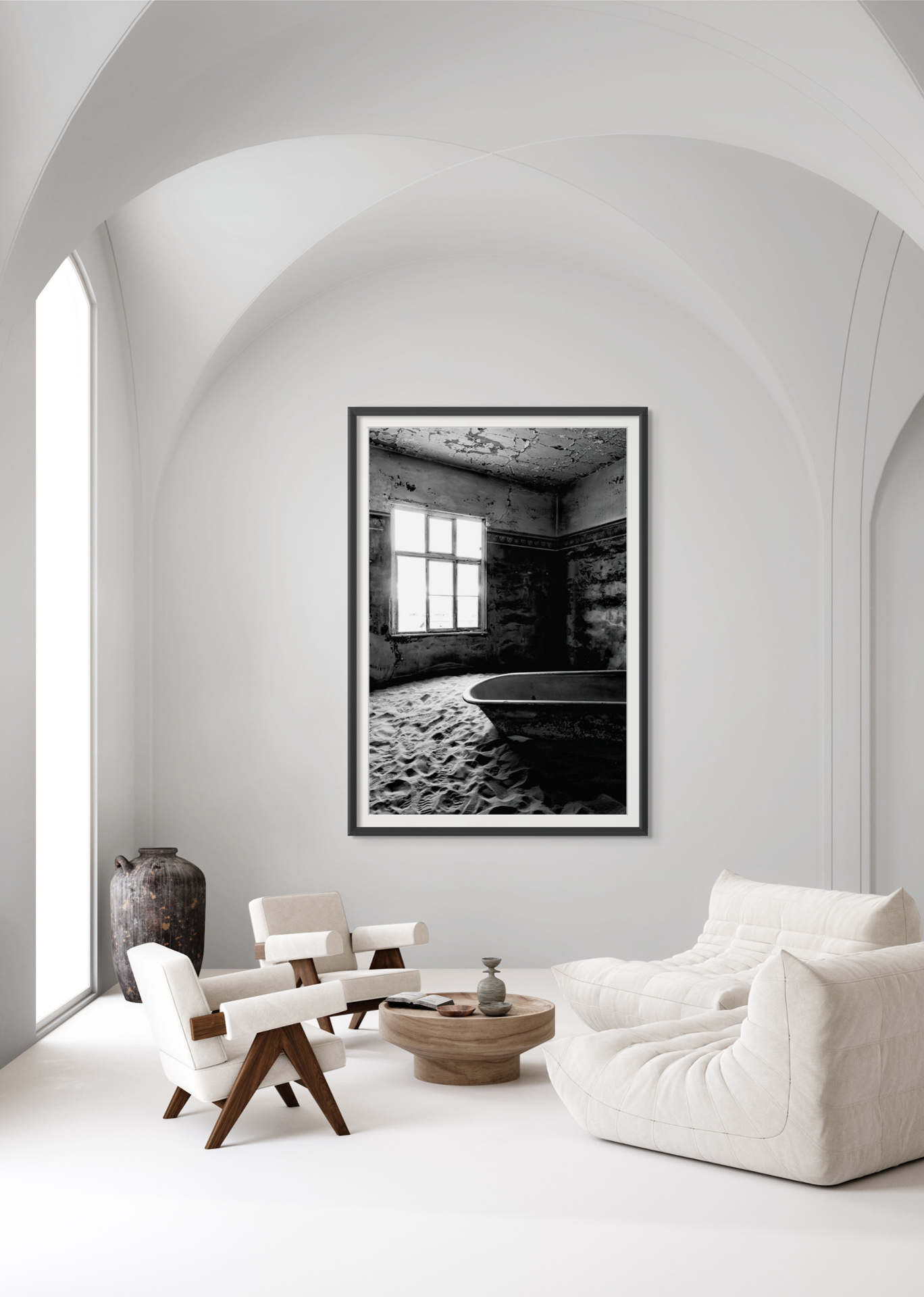
Empty Nest
"Empty Nest, Kolmanskop, Namibia"
In the fading light of late afternoon, a bathtub sits abandoned in a room slowly being reclaimed by the Namib Desert. Half-buried in sand, surrounded by peeling walls and broken windows, it remains as an unlikely reminder of comfort in a place where almost everything human has disappeared.
Empty Nest was photographed inside one of Kolmanskop’s former boarding houses, where rooms that once held the ordinary rhythms of daily life now stand open to the desert. Sand has crossed the threshold and settled where people once lived, while the fractured architecture allows the landscape outside to become part of the room itself.
John 4:13–14
Jesus answered and said to her, “Whoever drinks of this water will thirst again, but whoever drinks of the water that I shall give him will never thirst. But the water that I shall give him will become in him a fountain of water springing up into everlasting life.”
The scripture from John 4:13–14 gives the photograph its deeper meaning. The bathtub was created for water—to cleanse, refresh and restore. Yet here it stands completely dry, surrounded by the very sand and aridity that define the Namib. Something once associated with comfort has become an image of absence.
That contrast is what gives Empty Nest its quiet tension.
Kolmanskop was built around the extraordinary wealth of Namibia's early diamond industry. For a time, its residents enjoyed a remarkable level of comfort in the middle of an otherwise unforgiving desert. Homes, schools, hospitals and boarding houses were constructed with the expectation that the settlement would endure. When the diamonds declined and the population eventually departed, the desert began to reclaim what had been built.
Today, the bath remains—but the water, the people and the life that surrounded it are gone.
The image therefore becomes more than a study of an abandoned interior. It asks a simple question: what truly satisfies? The physical bath represents something that could provide temporary refreshment, while the scripture points towards something enduring—the living water offered by Christ.
The black and white treatment removes the distraction of colour and concentrates the image on form, texture and light. The smooth curve of the bathtub contrasts with the granular movement of the sand; deteriorating walls meet the harsh geometry of the window frames; and the remaining light gives the otherwise abandoned room a quiet sense of presence.
There is also something deeply human in the title. A nest is a place of shelter, belonging and life. This nest is empty. Yet the emptiness does not necessarily represent an ending. Within the biblical context, it becomes an invitation to consider where lasting life and renewal are actually found.
Empty Nest forms part of Craig Fouché’s continuing body of work exploring the abandoned places of Southern Africa through photography and Scripture. It is a study of impermanence, earthly comfort and spiritual thirst, using one simple object to speak to something considerably larger.
Presented as a signed and embossed Open Edition print, Empty Nest is suited to collectors of fine art photography who appreciate African landscapes and interiors with a deeper narrative—works that invite contemplation rather than simply recording a place.
This is a signed and embossed Open Edition print.
Empty Nest
Empty Nest
"Empty Nest, Kolmanskop, Namibia"
In the fading light of late afternoon, a bathtub sits abandoned in a room slowly being reclaimed by the Namib Desert. Half-buried in sand, surrounded by peeling walls and broken windows, it remains as an unlikely reminder of comfort in a place where almost everything human has disappeared.
Empty Nest was photographed inside one of Kolmanskop’s former boarding houses, where rooms that once held the ordinary rhythms of daily life now stand open to the desert. Sand has crossed the threshold and settled where people once lived, while the fractured architecture allows the landscape outside to become part of the room itself.
John 4:13–14
Jesus answered and said to her, “Whoever drinks of this water will thirst again, but whoever drinks of the water that I shall give him will never thirst. But the water that I shall give him will become in him a fountain of water springing up into everlasting life.”
The scripture from John 4:13–14 gives the photograph its deeper meaning. The bathtub was created for water—to cleanse, refresh and restore. Yet here it stands completely dry, surrounded by the very sand and aridity that define the Namib. Something once associated with comfort has become an image of absence.
That contrast is what gives Empty Nest its quiet tension.
Kolmanskop was built around the extraordinary wealth of Namibia's early diamond industry. For a time, its residents enjoyed a remarkable level of comfort in the middle of an otherwise unforgiving desert. Homes, schools, hospitals and boarding houses were constructed with the expectation that the settlement would endure. When the diamonds declined and the population eventually departed, the desert began to reclaim what had been built.
Today, the bath remains—but the water, the people and the life that surrounded it are gone.
The image therefore becomes more than a study of an abandoned interior. It asks a simple question: what truly satisfies? The physical bath represents something that could provide temporary refreshment, while the scripture points towards something enduring—the living water offered by Christ.
The black and white treatment removes the distraction of colour and concentrates the image on form, texture and light. The smooth curve of the bathtub contrasts with the granular movement of the sand; deteriorating walls meet the harsh geometry of the window frames; and the remaining light gives the otherwise abandoned room a quiet sense of presence.
There is also something deeply human in the title. A nest is a place of shelter, belonging and life. This nest is empty. Yet the emptiness does not necessarily represent an ending. Within the biblical context, it becomes an invitation to consider where lasting life and renewal are actually found.
Empty Nest forms part of Craig Fouché’s continuing body of work exploring the abandoned places of Southern Africa through photography and Scripture. It is a study of impermanence, earthly comfort and spiritual thirst, using one simple object to speak to something considerably larger.
Presented as a signed and embossed Open Edition print, Empty Nest is suited to collectors of fine art photography who appreciate African landscapes and interiors with a deeper narrative—works that invite contemplation rather than simply recording a place.
This is a signed and embossed Open Edition print.
Price range: $800.00 through $1 300.00
Print Information
The Cameras
Your Subtitle Goes Here
Every photograph begins with the camera it was created on. Whether captured on traditional photographic film or a modern digital camera, every image is produced with the same commitment to craftsmanship and authenticity.
Film negatives and transparencies are personally developed by hand before being professionally scanned and prepared for printing. Digital photographs are captured in RAW format and carefully processed to preserve the original scene rather than alter it.
Large Format
Shen-Hao 4×5
4×10
5×7
8×10
Korona 7×17
Pinhole Cameras
Medium Format
Baby Rolleiflex
Yashica 44
Yashica Mat 124
Pentax 645N
Mamiya 645 1000S
Pentax 6×7
Fuji GX617 Professional
Various panoramic roll-film systems
35mm
Nikon F5
Nikon F6
Digital
Nikon D800E
Nikon D4
Nikon D5
Fujifilm GFX100
The Collections
Your Subtitle Goes Here
Every collection represents years of exploration, patience and careful craftsmanship. Some photographs are captured digitally, while others originate on traditional photographic film.
Film photographs are developed by hand before being scanned using professional equipment. Digital RAW files receive only careful tonal and colour refinement, preserving the integrity of the original photograph.
Collections are available as either Open Editions or Limited Editions, depending on the artwork.
The Triptych Collection Sizes
Your Subtitle Goes Here
Triptych Size Guide
For Triptych Collection artworks, the selected size applies consistently across all three panels.
In compositions where the side panels are portrait and the centre panel is landscape, the selected size refers to the maximum height of the artwork. For example, when A3 is selected, the two portrait side panels are produced to the A3 long dimension, and the centre landscape panel is scaled proportionally to match that same height.
Where all three panels are landscape or all three are portrait, the selected format remains consistent throughout the set — A0 is A0, A1 is A1, A2 is A2 and A3 is A3. Sizes are not mixed between panels.
Available Triptych Collection sizes: A0, A1, A2 and A3.
The Editions
Your Subtitle Goes Here
Limited Editions
Limited Editions are permanently restricted to 25 prints worldwide, regardless of the size or medium selected.
Once the edition has sold out, no additional prints of that artwork will ever be produced.
Signing & Numbering
Every Limited Edition print is individually signed, embossed and accompanied by a Certificate of Authenticity.
Each print is hand-numbered—for example: 10/25
This indicates the tenth print produced from a total edition of twenty-five.
The Photographic Process
Your Subtitle Goes Here
Many CFP Prints artworks begin with traditional photographic film.
Each negative or transparency is developed by hand using carefully selected chemistry before being professionally scanned for printing. Every stage of the workflow is managed with the objective of faithfully reproducing the original photograph rather than digitally transforming it.
Every photograph represents a real moment, captured through experience, patience and light—not artificial intelligence.
The Printed Medium
Your Subtitle Goes Here
CFP Prints is produced exclusively on museum-quality Hahnemühle FineArt media.
Hahnemühle Cézanne Canvas
A 430 gsm, 100% cotton canvas offering exceptional colour depth, fine detail and long-term archival stability. Its natural matte surface makes it ideal for gallery-quality presentation.
Hahnemühle Photo Rag® Matt Baryta
A 308 gsm, a natural white, 100% cotton paper with a traditional barium sulphate coating. This paper offers rich blacks, luminous highlights, and refined surface texture. It is acid- and lignin-free, with certified age resistance.
Certificate of Authenticity
Your Subtitle Goes Here
Every CFP Prints artwork is accompanied by a Certificate of Authenticity (CoA)—a signed and embossed document that formally certifies the originality, provenance, and technical details of the artwork.
Issued with both Limited Edition and Open Edition works, the certificate confirms that the artwork was produced exclusively by CFP Prints using museum-quality archival materials and professional printing standards.
Collectors, galleries, and institutions are encouraged to retain the Certificate of Authenticity with the artwork at all times. It forms an important part of the artwork’s provenance and assists in verifying authenticity for resale, exhibition, insurance, and archival cataloguing.
Caring for Your Print
Your Subtitle Goes Here
Every CFP Prints artwork is produced using museum-quality archival materials designed to provide exceptional longevity when properly cared for.
To help preserve the beauty of your artwork for generations:
- Avoid prolonged exposure to direct sunlight or strong reflected light.
- Dust gently with a soft, dry microfibre cloth or soft artist’s brush. Never use household cleaners, solvents, or abrasive materials.
- Display or store your artwork in a dry, temperature-controlled environment, away from excessive humidity or heat.
- Canvas prints are protected with a professional matte archival varnish and may be gently cleaned with a soft, slightly damp cloth when necessary.
With appropriate care, your CFP Prints artwork will retain its richness, detail, and archival quality for many years.