
A Way Through the Wilderness – Orange River, Namibia
Price range: $800.00 through $1 300.00
A Way Through the Wilderness – Orange River, Namibia
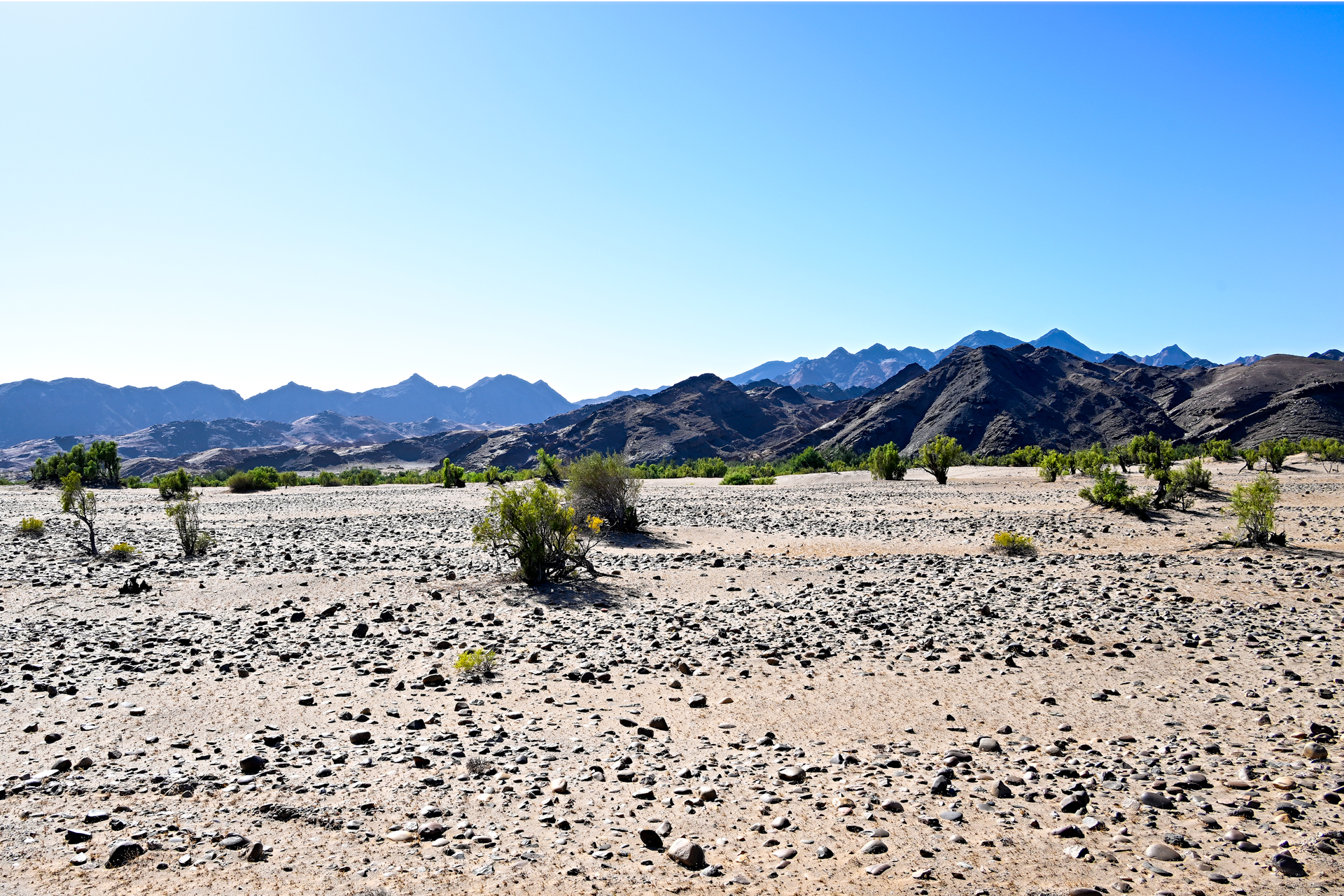
“A Way Through the Wilderness – Orange River, Namibia” looks across a vast and uncompromising landscape on the Namibian side of the Orange River, where the mountains of the Richtersveld rise in successive layers beyond a sun-baked plain. Photographed digitally during the morning as the desert heat began to strengthen, this expansive scene captures a land seemingly stripped to its essentials—stone, sand, mountains, sky and the tenacious vegetation capable of surviving between them.
Across the foreground, thousands of dark stones lie scattered over pale earth, creating a natural mosaic that leads towards isolated shrubs and small trees. Their green foliage appears almost improbable against such an austere environment.
Beyond them, the terrain begins to rise.
Low, dark ridges give way to increasingly distant mountains, their jagged silhouettes overlapping one another until the furthest peaks dissolve into the blue atmospheric haze. Above everything stretches an immense, cloudless sky, occupying almost half the composition and reinforcing the extraordinary sense of openness that defines this remote landscape.
There is no obvious road through the scene.
And yet there is a way.
Isaiah 43:19
Behold, I will do a new thing,
Now it shall spring forth;
Shall you not know it?
I will even make a road in the wilderness
And rivers in the desert.
The words of Isaiah 43:19 find an unusually literal expression here.
Just beyond the visible landscape lies the Orange River—the great watercourse that forms the international boundary between South Africa and Namibia through this region. Its presence creates one of Southern Africa's most remarkable contrasts: permanent water travelling through an environment where much of the surrounding land appears almost entirely without it.
Yet from this particular viewpoint, the river cannot be seen.
That absence strengthens the meaning of the photograph.
The viewer encounters the wilderness first: the dry river-like channels, scattered stones, sparse vegetation and formidable mountain ranges. Water exists nearby, but the landscape gives little indication of the life-giving artery passing through it.
It is a fitting visual expression of the promise contained within Isaiah: a river in the desert and a way where no obvious way appears to exist.
The Richtersveld landscape is among the most geologically dramatic in Southern Africa. Here, mountain chains rise abruptly from gravel plains and ancient drainage systems, their exposed surfaces carrying an extraordinary range of colours and textures. From charcoal and slate to muted ochre, silver-grey and burnt earth, the mountains seem almost devoid of softness.
The vegetation tells another story.
Each shrub and tree visible across the plain represents adaptation on an extraordinary scale. Life here must contend with intense heat, scarce rainfall and terrain that offers little shelter. Nothing appears excessive. Everything that survives does so economically.
By approximately eight in the morning, the desert light is already becoming hard and brilliant. Shadows contract. Stone begins to radiate heat. Distance becomes increasingly veiled by atmospheric haze.
Rather than disguising these conditions, A Way Through the Wilderness embraces them.
The uncompromising light belongs to the place.
This is not a romanticised desert softened by sunset. It is the Richtersveld under the strengthening African sun—exposed, immense and honest.
For collectors, the photograph offers both landscape and metaphor. The eye naturally searches for a route through the mountains, moving from the scattered vegetation of the foreground towards the distant passes and peaks.
Like the scripture that accompanies it, the work speaks of journeys whose destination may be known even when the path itself remains unseen.
The wilderness does not promise an easy passage.
It simply reminds us that a way can exist.
This is a signed and embossed Open Edition print.
A Way Through the Wilderness – Orange River, Namibia
A Way Through the Wilderness – Orange River, Namibia
“A Way Through the Wilderness – Orange River, Namibia” looks across a vast and uncompromising landscape on the Namibian side of the Orange River, where the mountains of the Richtersveld rise in successive layers beyond a sun-baked plain. Photographed digitally during the morning as the desert heat began to strengthen, this expansive scene captures a land seemingly stripped to its essentials—stone, sand, mountains, sky and the tenacious vegetation capable of surviving between them.
Across the foreground, thousands of dark stones lie scattered over pale earth, creating a natural mosaic that leads towards isolated shrubs and small trees. Their green foliage appears almost improbable against such an austere environment.
Beyond them, the terrain begins to rise.
Low, dark ridges give way to increasingly distant mountains, their jagged silhouettes overlapping one another until the furthest peaks dissolve into the blue atmospheric haze. Above everything stretches an immense, cloudless sky, occupying almost half the composition and reinforcing the extraordinary sense of openness that defines this remote landscape.
There is no obvious road through the scene.
And yet there is a way.
Isaiah 43:19
Behold, I will do a new thing,
Now it shall spring forth;
Shall you not know it?
I will even make a road in the wilderness
And rivers in the desert.
The words of Isaiah 43:19 find an unusually literal expression here.
Just beyond the visible landscape lies the Orange River—the great watercourse that forms the international boundary between South Africa and Namibia through this region. Its presence creates one of Southern Africa's most remarkable contrasts: permanent water travelling through an environment where much of the surrounding land appears almost entirely without it.
Yet from this particular viewpoint, the river cannot be seen.
That absence strengthens the meaning of the photograph.
The viewer encounters the wilderness first: the dry river-like channels, scattered stones, sparse vegetation and formidable mountain ranges. Water exists nearby, but the landscape gives little indication of the life-giving artery passing through it.
It is a fitting visual expression of the promise contained within Isaiah: a river in the desert and a way where no obvious way appears to exist.
The Richtersveld landscape is among the most geologically dramatic in Southern Africa. Here, mountain chains rise abruptly from gravel plains and ancient drainage systems, their exposed surfaces carrying an extraordinary range of colours and textures. From charcoal and slate to muted ochre, silver-grey and burnt earth, the mountains seem almost devoid of softness.
The vegetation tells another story.
Each shrub and tree visible across the plain represents adaptation on an extraordinary scale. Life here must contend with intense heat, scarce rainfall and terrain that offers little shelter. Nothing appears excessive. Everything that survives does so economically.
By approximately eight in the morning, the desert light is already becoming hard and brilliant. Shadows contract. Stone begins to radiate heat. Distance becomes increasingly veiled by atmospheric haze.
Rather than disguising these conditions, A Way Through the Wilderness embraces them.
The uncompromising light belongs to the place.
This is not a romanticised desert softened by sunset. It is the Richtersveld under the strengthening African sun—exposed, immense and honest.
For collectors, the photograph offers both landscape and metaphor. The eye naturally searches for a route through the mountains, moving from the scattered vegetation of the foreground towards the distant passes and peaks.
Like the scripture that accompanies it, the work speaks of journeys whose destination may be known even when the path itself remains unseen.
The wilderness does not promise an easy passage.
It simply reminds us that a way can exist.
This is a signed and embossed Open Edition print.
Price range: $800.00 through $1 300.00
Print Information
The Cameras
Your Subtitle Goes Here
Every photograph begins with the camera it was created on. Whether captured on traditional photographic film or a modern digital camera, every image is produced with the same commitment to craftsmanship and authenticity.
Film negatives and transparencies are personally developed by hand before being professionally scanned and prepared for printing. Digital photographs are captured in RAW format and carefully processed to preserve the original scene rather than alter it.
Large Format
Shen-Hao 4×5
4×10
5×7
8×10
Korona 7×17
Pinhole Cameras
Medium Format
Baby Rolleiflex
Yashica 44
Yashica Mat 124
Pentax 645N
Mamiya 645 1000S
Pentax 6×7
Fuji GX617 Professional
Various panoramic roll-film systems
35mm
Nikon F5
Nikon F6
Digital
Nikon D800E
Nikon D4
Nikon D5
Fujifilm GFX100
The Collections
Your Subtitle Goes Here
Every collection represents years of exploration, patience and careful craftsmanship. Some photographs are captured digitally, while others originate on traditional photographic film.
Film photographs are developed by hand before being scanned using professional equipment. Digital RAW files receive only careful tonal and colour refinement, preserving the integrity of the original photograph.
Collections are available as either Open Editions or Limited Editions, depending on the artwork.
The Triptych Collection Sizes
Your Subtitle Goes Here
Triptych Size Guide
For Triptych Collection artworks, the selected size applies consistently across all three panels.
In compositions where the side panels are portrait and the centre panel is landscape, the selected size refers to the maximum height of the artwork. For example, when A3 is selected, the two portrait side panels are produced to the A3 long dimension, and the centre landscape panel is scaled proportionally to match that same height.
Where all three panels are landscape or all three are portrait, the selected format remains consistent throughout the set — A0 is A0, A1 is A1, A2 is A2 and A3 is A3. Sizes are not mixed between panels.
Available Triptych Collection sizes: A0, A1, A2 and A3.
The Editions
Your Subtitle Goes Here
Limited Editions
Limited Editions are permanently restricted to 25 prints worldwide, regardless of the size or medium selected.
Once the edition has sold out, no additional prints of that artwork will ever be produced.
Signing & Numbering
Every Open and Limited Edition print is individually signed, embossed and accompanied by a Certificate of Authenticity.
Each Limited Edition print is hand-numbered—for example: 10/25
This indicates the tenth print produced from a total edition of twenty-five.
The Photographic Process
Your Subtitle Goes Here
Many CFP Prints artworks begin with traditional photographic film.
Each negative or transparency is developed by hand using carefully selected chemistry before being professionally scanned for printing. Every stage of the workflow is managed with the objective of faithfully reproducing the original photograph rather than digitally transforming it.
Every photograph represents a real moment, captured through experience, patience and light—not artificial intelligence.
The Printed Medium
Your Subtitle Goes Here
CFP Prints is produced exclusively on museum-quality Hahnemühle FineArt media.
Hahnemühle Cézanne Canvas
A 430 gsm, 100% cotton canvas offering exceptional colour depth, fine detail and long-term archival stability. Its natural matte surface makes it ideal for gallery-quality presentation.
Hahnemühle Photo Rag® Matt Baryta
A 308 gsm, a natural white, 100% cotton paper with a traditional barium sulphate coating. This paper offers rich blacks, luminous highlights, and refined surface texture. It is acid- and lignin-free, with certified age resistance.
Certificate of Authenticity
Your Subtitle Goes Here
Every CFP Prints artwork is accompanied by a Certificate of Authenticity (CoA)—a signed and embossed document that formally certifies the originality, provenance, and technical details of the artwork.
Issued with both Limited Edition and Open Edition works, the certificate confirms that the artwork was produced exclusively by CFP Prints using museum-quality archival materials and professional printing standards.
Collectors, galleries, and institutions are encouraged to retain the Certificate of Authenticity with the artwork at all times. It forms an important part of the artwork’s provenance and assists in verifying authenticity for resale, exhibition, insurance, and archival cataloguing.
Caring for Your Print
Your Subtitle Goes Here
Every CFP Prints artwork is produced using museum-quality archival materials designed to provide exceptional longevity when properly cared for.
To help preserve the beauty of your artwork for generations:
- Avoid prolonged exposure to direct sunlight or strong reflected light.
- Dust gently with a soft, dry microfibre cloth or soft artist’s brush. Never use household cleaners, solvents, or abrasive materials.
- Display or store your artwork in a dry, temperature-controlled environment, away from excessive humidity or heat.
- Canvas prints are protected with a professional matte archival varnish and may be gently cleaned with a soft, slightly damp cloth when necessary.
With appropriate care, your CFP Prints artwork will retain its richness, detail, and archival quality for many years.